


Scent Notes of Muscari on an April Evening
Thoughts and ideas prompted by a session of sniffing muscari in the polytunnels at sundown, one warm April evening.
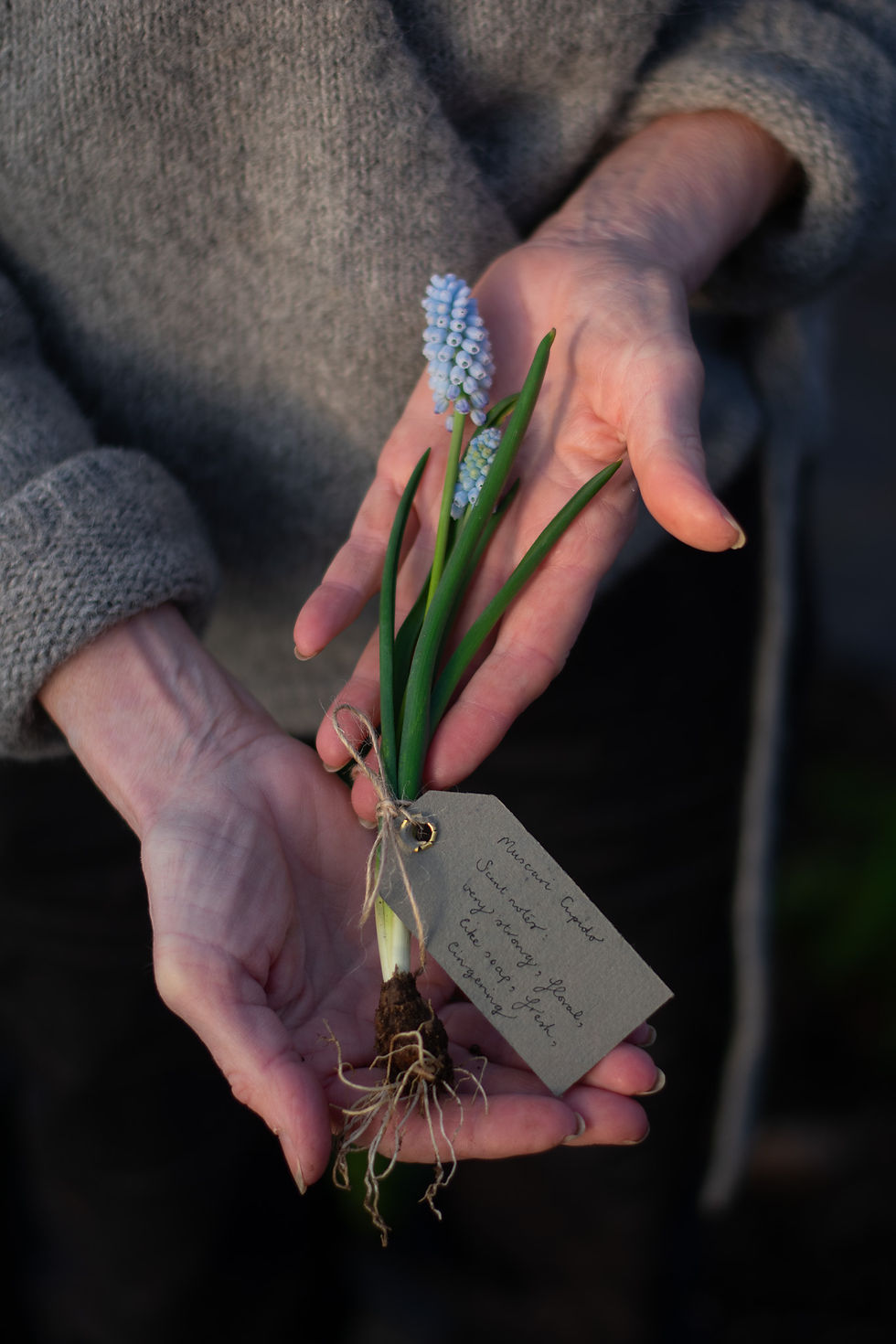
The scent of flowers is a language spoken directly to the oldest parts of us; our shared histories, our evolution with the natural world, our memories, emotions, and instincts. Long before words, humans followed the paths of seasons, through flowers and plants, landscapes and weather, looking for signals of fertility, nourishment, and the promise of survival. Floral scent binds us to cycles that are far older than us, yet we know them in our cells and in our bones, we feel them. A single inhale of the scent of a flower summons an entire landscape of feeling; a garden, a fleeting moment, a summer evening, the ache of something passed, or something we can't name. To smell flowers is to participate in an ancient conversation between the earth and the body. There is such a joy in pausing to notice them or in trying to describe them with others, "close your eyes, what do you smell?" I often think it is like passing food around a table. In a world that pulls us towards distraction and abstraction, flowers return us to sensation. They remind us that the beauty of the natural world is a form of attention and a belonging. To tune in to the scent of flowers is to remember ourselves as part of the living world, that we are animals that are porous and receptive, capable of being moved by something as ephemeral as a flower and held by something as enduring as memory. Scent as Place
Scent is a kind of geography, a map, a place that is undiscovered or revisited, somewhere you travel to, a moment of escape. The scent of a flower is a trace of something, a room you once stood in, a person you spent time with, a part of your life you didn’t realise you remembered. It’s a form of orientation, taking you somewhere, bringing you back. Scent moves through us carrying descriptors of everything encountered in our world: soil, weather, food, plants, minerals, elements, temperature, light, day, night. And our lives: memories, moments, relationships. Scent is a remarkable sense, it is lived in and felt, layered and shifting.
The Problem of Language
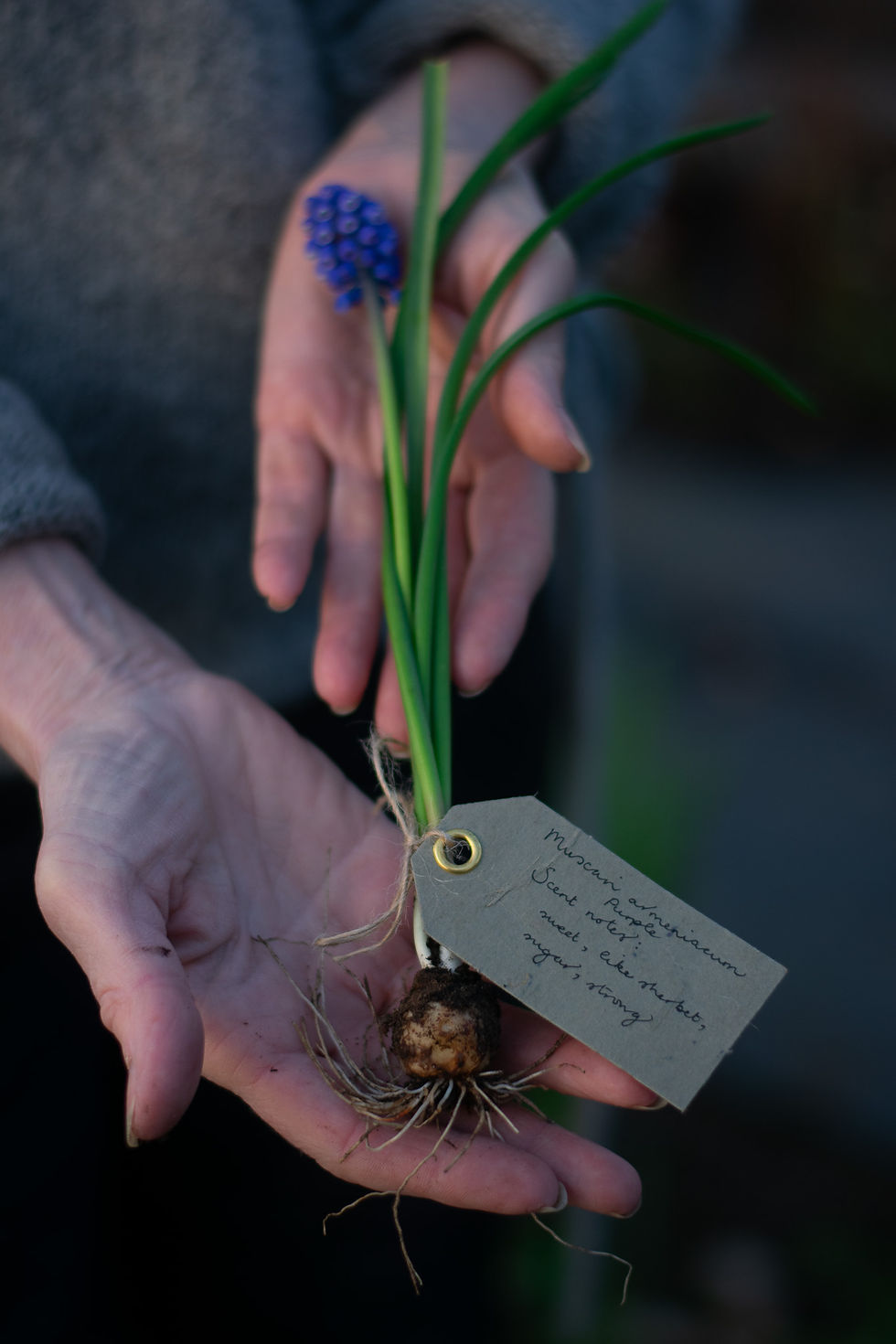
Part of the fascination is that scent can’t be fully captured in words. You keep returning, trying to understand it, trying to place it, trying to name it. Is it sweet? Savoury? Floral? Earthy? Not quite. Something else. Sniffing, searching, sniffing, naming. Smelling becomes a form of thinking, and it doesn’t always resolve neatly. Words arrive too late or carry associations that don’t quite belong. Sometimes the senses overlap, sometimes you attribute scent to a colour. The eye acknowledges the colour, so that the scent arrives already shaped into something we recognise. The eye offers a hypothesis, and the nose adjusts to meet it. There is no adequate vocabulary for scent, only an approximation. You can only describe what you already know. Naming becomes an act of translation, and translation always alters the original. Even in perfumery, where scent is broken into notes and structures, language only gestures toward the experience, it cannot contain it. And yet, the act of naming still matters. To name a scent is to bring it closer, to pay attention in a way that sharpens perception. It is a way of experiencing flowers more deeply, even if the description never fully holds. The scent of flowers is a language that is older than words, tied to memory and survival, rooted in place and time, just out of reach of explanation. Familiar and unknowable at the same time. When there seems to be no adequate vocabulary of scent, we fall back on approximations and metaphors.
Muscari as Scent Subjects
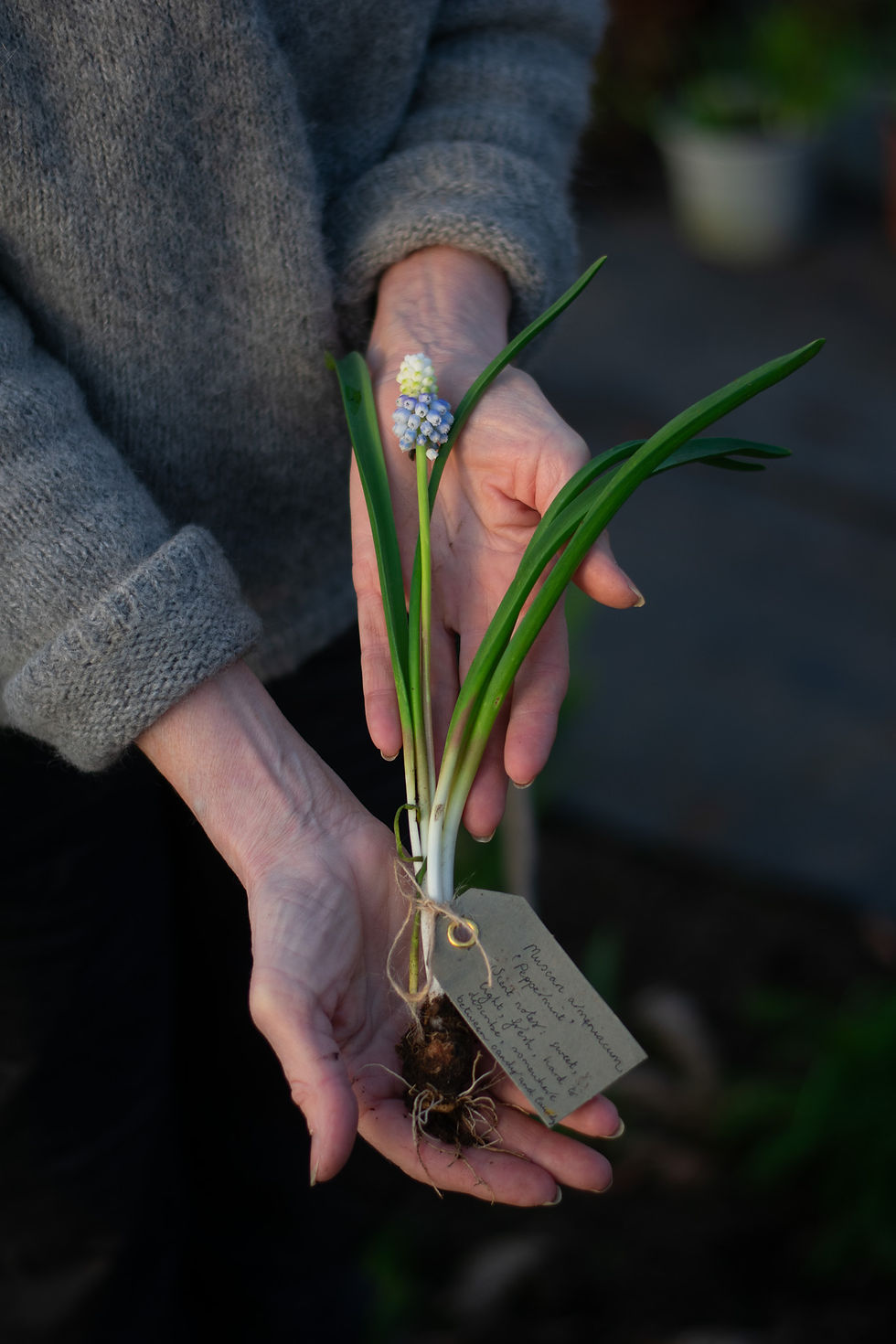
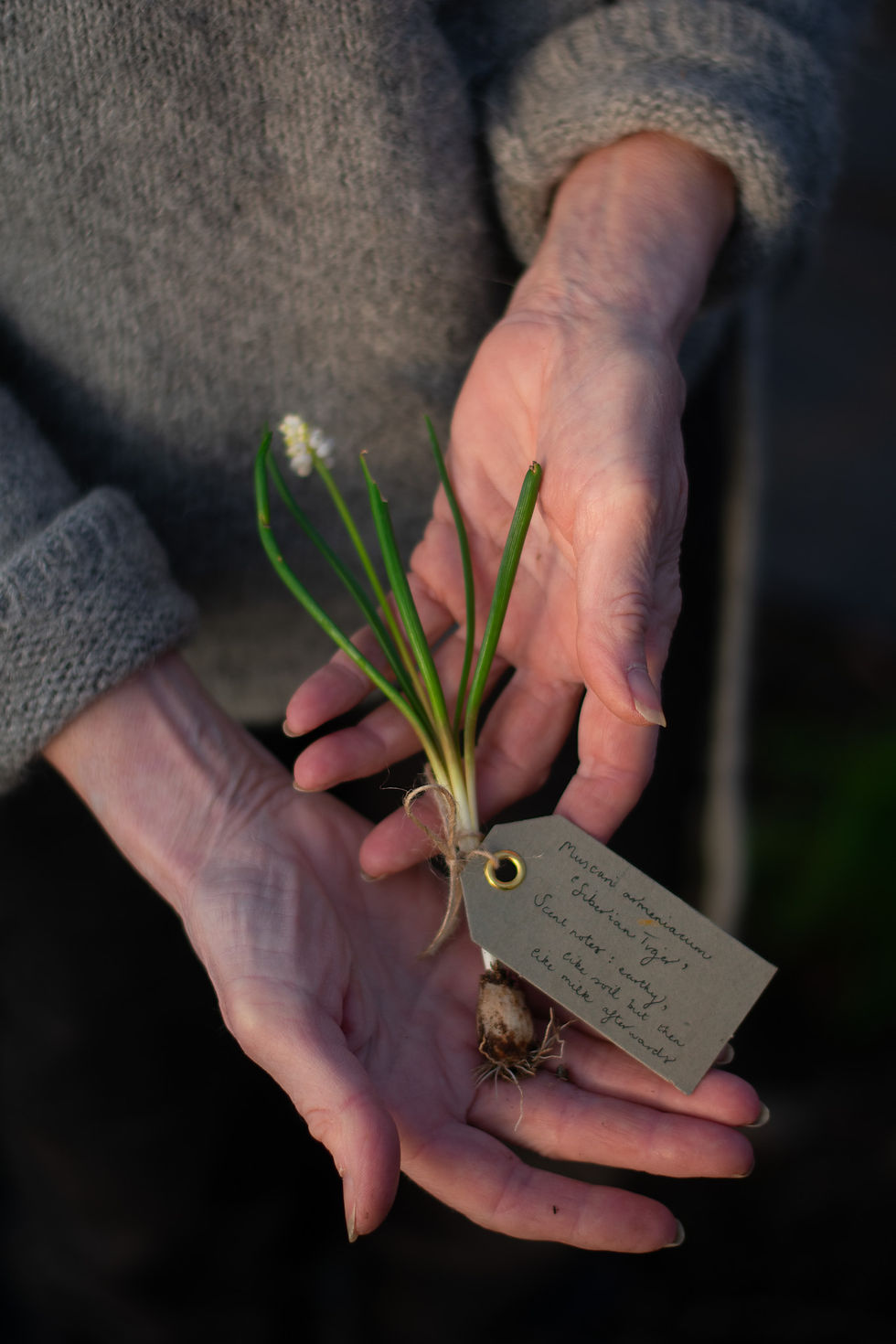
Muscari are the perfect subjects. Early one evening, we spent some time cataloguing scent notes in the polytunnel with the lingering heat of a sunny day rapidly disappearing as the sun lowered. Everything about muscari makes you want to investigate them more closely. The repeated florets each contain tiny stamens of pollen and the blues feel otherworldly, cool, as wide as skies, and as deep as oceans. Their scent is unexpected. There is a sweetness, but not always the floral sweetness we expect from flowers. Their scent leans in all directions, floral, fruity, earthy, myrrh, woody, and then settles, sometimes into language and sometimes not quite. It is difficult to separate scent from appearance. The blue suggests coolness, and so the nose looks for it, but the scent is warmer than expected, more rounded. This slight dissonance makes it harder to fix in the mind. There is variation between them, each particular variety holds a slightly different note. They are not showy like a rose, identifying their fragrances takes patience. They say, stay with me.
Collectivism
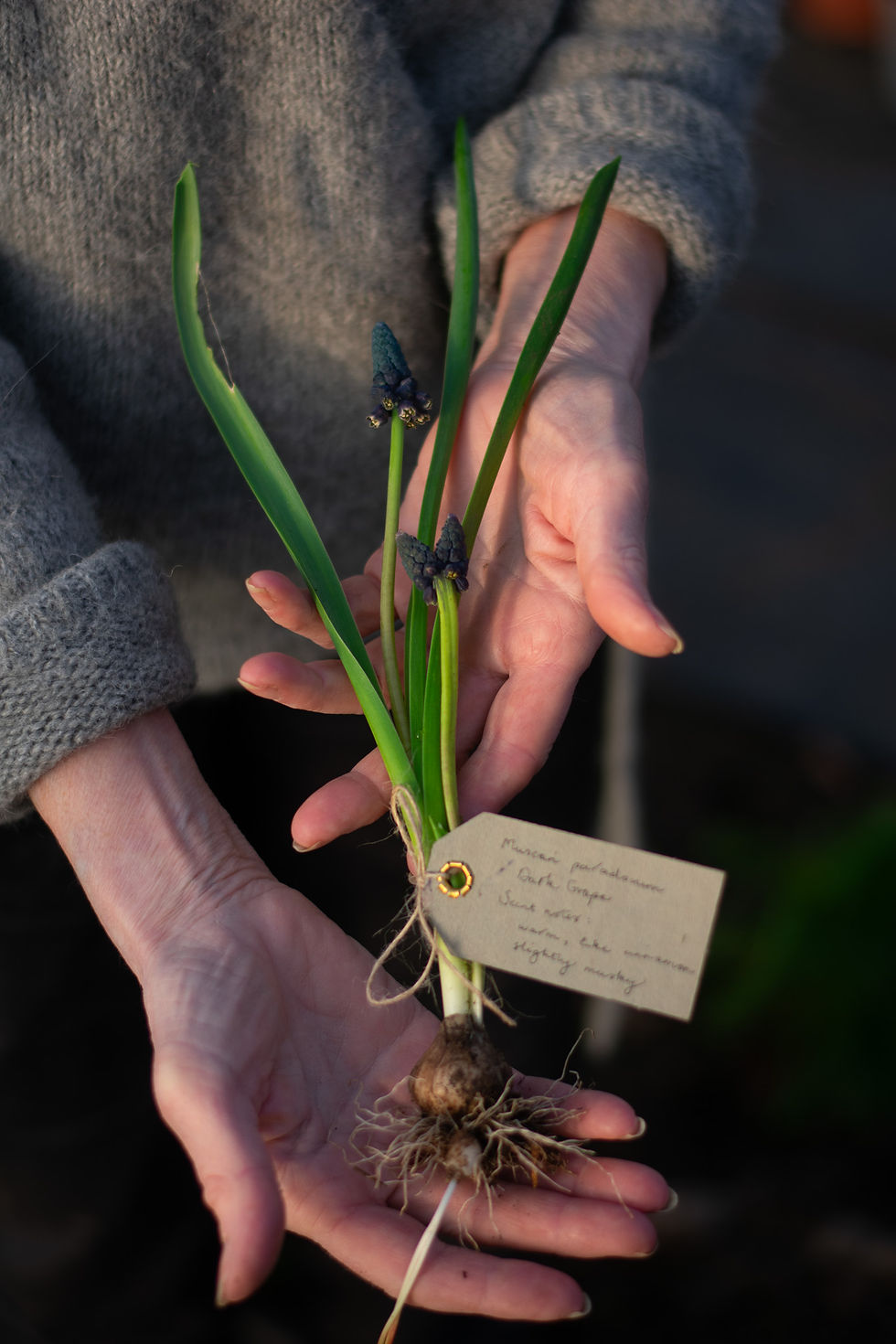
A scent is rarely a single thing, especially when it comes to flowers. One stem of muscari offers a little scent, but a cluster in the ground or a bunch gathered together in the hand creates a more resonant symphony. In order to get more of a handle on the individual scents, we bunch them together and sniff them deeply and repeatedly. Or we get down on all fours and sniff them directly in the ground. It's a heady exercise. The scent of multiple flowers has more intensity because their collective compounds come together to maximise pollination. While a single flower emits a subtle scent designed for close range navigation, a collection of flowers creates a cloud of scent that acts as a beacon for insects. Everything about flowers is about messaging, and what better way to send a message than to say it over and over. I love to think of the word bouquet in the context of scent, it's the perfect way to describe the harmony and composition of flowers when they come together as a collection of scents, like a perfume or a wine.
The Right Moment
The scent of flower is not constant, it depends on many factors like time, temperature, weather. Noticing these accumulations and drifts is one of the most fascinating things about being with flowers. Flowers hold their scent and let it go in response to conditions, warmth, light, moisture, and the presence of pollinators. As the day warms, scents diffuse more readily into the air. By late afternoon, and into the evening, this can become more intense. There are some flowers, like night-scented stock and honeysuckle that wait until the end of the day or the evening. In some cases, the release of scent aligns with cycles of pollination, timed to the movement of insects and the cooling of the air. Even in muscari, this shift is noticeable throughout the day. On warmer days and with the presence of more insects, their scent is everywhere. Flowers evolved scents to communicate with pollinators. The volatile compounds they release are signals, come closer, there is something you need here. If humans are not the intended audience, why do we find the scent of flowers so powerful and intoxicating? Faces buried, intoxicated, delighted. Many of the scent molecules in flowers are like the compounds found in ripe fruit and herbs. These are all things that are linked to nourishment and seasonal abundance, and therefore survival. When you smell a flower, you are responding to an innate chemical vocabulary your body already understands. Smell is processed through the limbic system, the part of the brain tied to memory and emotion, before it reaches the areas responsible for language or logic. That’s why smelling a flower feels so hard to explain, you are feeling something before you think it. What we encounter is only ever a moment within a larger process of evolution and survival, something unfolding, then gone, it’s beautiful. Even if we’re not consciously aware of it, we respond to these cues. They signal growth, transience, and a moment that won’t last. But we try to capture it anyway, by any means.
The Muscari Scent Ledger


Comments